Required viewing:
I cannot imagine a more captivating talk on music appreciation -- he accomplishes so much in a very very short time period.
Published Wed 29 October 2008
Required viewing:
I cannot imagine a more captivating talk on music appreciation -- he accomplishes so much in a very very short time period.
Published Tue 28 October 2008
Live at Montreaux in 2001. A fantastic job by these guys, who also had a remarkable duet album.
http://www.youtube.com/watch?v=RgqM_m_5Kzw
Published Mon 27 October 2008

This is such a delightful word I have caught myself using, and is particularly noteworthy in its conventionality of etymology. It seems to me (and others) that its slow introduction to the English language is due to the Spanish word for "storm," tormenta. Slowly -- possibly through the American/Mexican border, the word has begun to take on an English meaning of "stormlike, thunderous, violent, fierce," or something of the like. In a hundred years, Webster will surely have it listed, with a date near 2000, and show the etymology is indeed Spanish.
A Google search for "tormentuous" reveals far too many results to be merely the result of freak chance, and all uses tend to have the same meaning. And this is no neologism contrived for an express purpose by a single person or group. Instead, we are witnessing the slow growth (1,040 Google hits) of a new word growing by traditional methods of linguistic transformation.
Fantastic.
Think of this memetically: Why has it taken off so well? It must be, as a word, good for its own survival, in out-competing others like it for the same "resources." In this case, the word mimicks the sound of "torrential," a word already established and well associated with storm-like traits, as well as "tempestuous," which invokes rage -- particularly in nature. By inserting the Spanish word "tormenta," we have an absolutely plausible English word that could mean exactly "storm-like," but which benefits from the quasi-homophones' meanings of "violent amounts (of water)" and "windstormy and angrily emotional." Then there's "tumultuous," which implies disorder. Finally, there's the English "torment," which implies torture. When I think of "tormentuous," I tend to combine all four: an emotional/angry disordered paroxysm of emotional outlash, a deluge of psychological anguish, destroying everything in its path. This could be metaphorical.
Because of these homophones, it's possible that "tormentuous" is a particularly common mutation in human minds, and one that doesn't tend to be scoffed at or lead to confusion -- it doesn't have any inherent survival disadvantages. In this case, we could be seeing many separate mutation events happening (as well as standard reproduction), and subsequently we will see the populations combine and grow by mutually supporting themselves.
What a fantastic confluence! Because of it, we have an opportunity to watch this word -- which has tremendous selective advantages -- really take off.
Published Mon 27 October 2008
http://www.youtube.com/watch?v=mxs2nRekH2w
Stevie's a bit of a diva here, but he's also relatively young and probably excited as hell! That head shaking vibrato isn't a great habit though -- he stopped doing that later on in his career, but he never stopped letting the music move him. He's a musician beyond compare, with a golden voice and YouTube videos that are sensational to browse.
Update: I notice that Diana Ross was born in 1944, and Stevie Wonder in 1950. When this was recorded, that 6 year difference qualified for an "older woman" joke. If this video dated somewhere around 1970, that would make Diana about 26, and Stevie 20. These are two young folks making jokes about their age, but as a twentysomething in 2008, they both seem exactly the same age -- baby boomers. At this time, however, it was a completely different story.
Was there a tension? Clearly, Diana probably felt that Stevie was way too young for her, and made the obligate joke. Stevie? I imagine he was elated to be sharing the stage with what might be the equivalent of his friend's famous older sister... and they were acting out a romantic tension! At around 1:40, look at Diana's body language leading into Stevie's tongue clicks (!!!). Something else, at the very least.
Finally, watch her strut over to him at the beginning! Quite a swagger.
Published Mon 27 October 2008
The Wall Street Journal on a Keith Jarrett album:
It is the most successful solo jazz album of all time, but Keith Jarrett wants to see each of the 3.5 million copies of "The Köln Concert" stomped into the ground.
(via Metafilter).
Published Sun 26 October 2008
Here's Sammy Davis Jr. being his bad self, with a truly kicking band behind him (and some very impressive soul girls!). Sammy seems a bit ridiculous here, spinning around underneath an enormous cutout of himself, but these were ridiculous times, ladies and gentlemen. His phrases are all timed so casually; it's almost as though he is contributing nearly nothing to the rhythm of the tune and letting the band take care of it all:
http://www.youtube.com/watch?v=OVFKTeq1b74
Bizarrely, this type of music eventually made a comeback to the mainstream to become part of a major label push towards a swing revival. The Cherry Poppin' Daddies, with Zoot Suit Riot, helped lead the charge as kids around the nation found their parents' dancing shoes to be quite comfortable indeed! However, the secret of this movement is that before it was polished up and dressed in expensive suits, it was a sweaty, shirtless, punk rock outgrowth, formed out of University of Oregon dropouts. Here are the Cherry Poppin' Daddies in Eugene, Oregon in 1993... the video is rather raw. I feel like I could catch Steve Perry's buzz through the interwebs and across 15 years:
http://www.youtube.com/watch?v=gxA1axGCwLs
And here's a video using their studio version, which sounds most authentically swing of their tunes -- it's the original arrangement, after all.
Published Sat 25 October 2008
Another one already, you say? Sounds great. This track was inspired in a large way by the Ben Folds Live CD -- the excitement of the crowd in singing the descant part along. This is a strong arrangement, and takes a very different tack than Don't Stop Me now. Here, the parts aren't as difficult to learn and sing, there's more reliance on descants, and the upper voices have similar rhythms far less frequently. Vowel juxtaposition is one of the greatest tools in differentiating "instruments," and by the end, the block is unified for a powerful finish. This was always a favorite to sing -- rather easy.
Army by Ben folds, TTBB, as sung by The Achordants. Audio includes original Ben Folds Five track and a UNC Achordants Pre-Master (before it was stripped of dynamics):
Let's get started then, shall we?
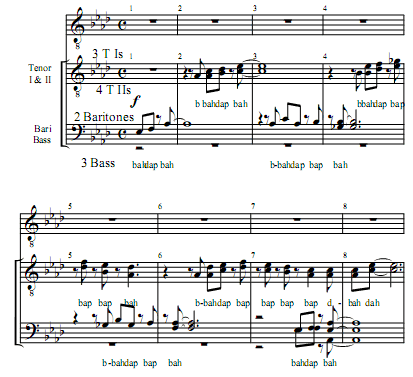
The opening is the recurring motif that the horns used, using very simple syllables (close to the ones Ben Folds himself uses in his concerts). It's scored with some pretty simple harmonizations of either line. My baritone section was loud as could possibly be imagined, so I dumped one of them into the Tenor II section, which, as you will see, is the one regularly split. In truth, this is nearly a five-part arrangement. The cutoff on the downbeats of the measures were easy to hit and very clean after a bit of practicing. In a cappella arranging, the alignment of cutoffs is incredibly important to make the group sound crisp.
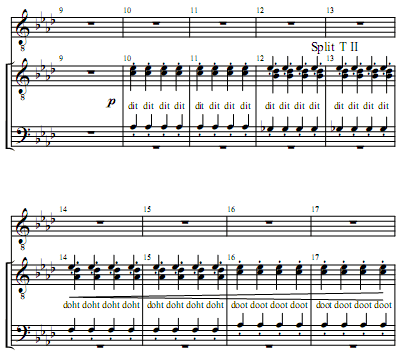
No basses, matching the piano part. The Split TII occurs over and over, but it's important that they know they tend to sit on the third when united -- when this is the case they should back off a bit. The change in vowel is just for variety's sake, and the crescendo on the "doot" (a quiet syllable) helps to make for an interesting pop when the "dit"s return:
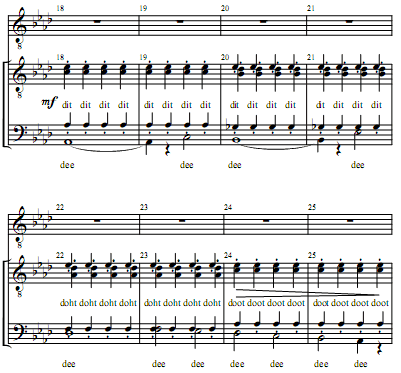
The basses enter with gusto! "Dee" is an excellent syllable for basses, since it's the brightest and most forward pure vowel, and the throat is widest when singing it. It helps the basses shoot overtones higher and brighter, and makes for a terrific blend. They are the center of attention here, and not really driving the action -- their syllable is different from the block, so they come out of the mix with a strong melodic line.
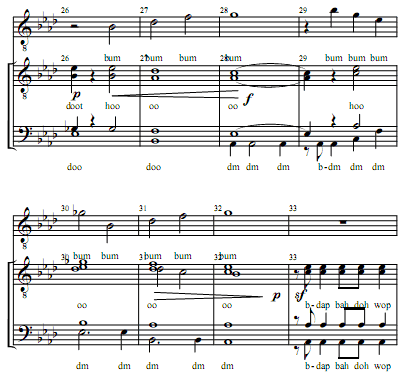
Here's the soft section, shaped dynamically as an eight-bar arch from piano to forte and back. Note the upper voices are aloweed to cadence firmly in m26 to bring their chords to a satisfying close; they only begin their sweep on beat three. In the meantime, the basses have already begun their whole notes on the downbeat of m26. By overlapping the beginnings and endings of phrases, a sense of continuity is gained. The piano arpeggios were eschewed and replaced with long chords, which is what the voice is good at. These long chords have carefully timed rests so all can breathe together, and in m26 and m29 a halfnote "pickup" is used as a launching point. In the second half, some internal melodies and extra notes were added. The "bum"s on the top were changed to "dah", since bum was too closed. Finally, notice how the basses start off with the "doo" sustained to help give the upper voices their initial energy (while they were busy cadencing), but when the upper voices are off and running, the basses are free to dmm their way through, providing some forward momentum taken from the drumbeat. Then in m33 is taken from the drumset pickups.
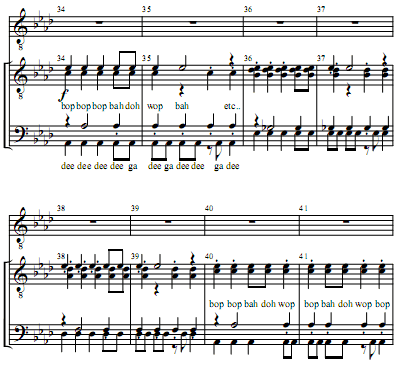
I should have written "wop" as "ahp" to help keep the pitch constant. Singers tended to read "bah doh wop" as almost a melody, where "doh" is slightly lower. Careful. In any case, the chord voicings are exactly the same as the first verse, and they stay identical for verses throughout. In this case, the upper voices are all singing different lines, but their differences are rhythmic and not melodic -- they are all still working together, and having similar open syllables helps the group sound like a united and active force. The T2s and B1s have the sustained halfnotes that somewhat feed off each other. The basses stand alone with their "dee"s, and so the group sounds dynamic and interesting; later on, the syllables will come together for a wall of sound.
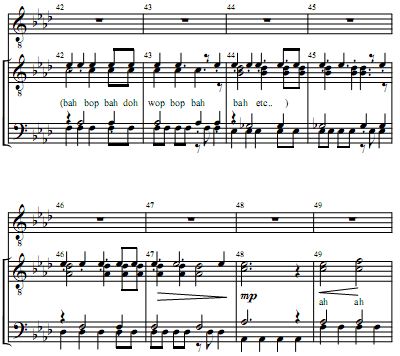
More of the same. I decided not to write in the saxophone part here, since the section is already going to far more exciting and loud than the opening one; also, the baritone line from the opening is already used very often, including in a "breakdown" section later. In m42, the basses go up high for their Fs (a new chord), and then descend note for note down to the Db. Although it's a big of a jump for them to get up this high, it's important that the music not get too heavy just yet. The bass part here is new, and the upper voices start their long chords earlier, in m48 and m49. Also, they're on the beat more directly.
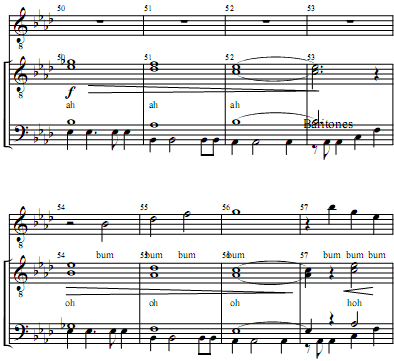
The basses this time have a different part -- it is more active and begins rhythmically earlier since the upper voices are already off and running. Basses have a rhythm that doesn't come anywhere from the song itself, but captures the rhythmic feel of this section -- they displace the eighth notes from measure to measure as well. Also, this interlude phrase is four measures longer than before, and has a different overall dynamic configuration.
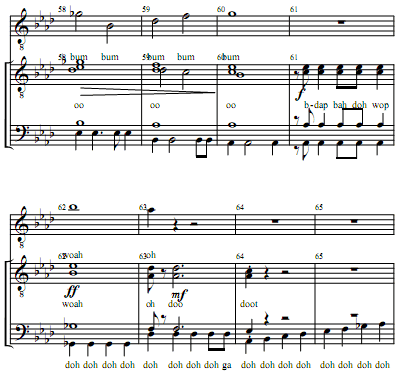
The bridge has the whole group harmonizing the lead ("woah" should be sung "wuh" in order to brighten it a bit, and also to help neutralize the syllable for the high voices). m63 shows typically upper voicewriting with a simple sustained note coming in on a weak beat.
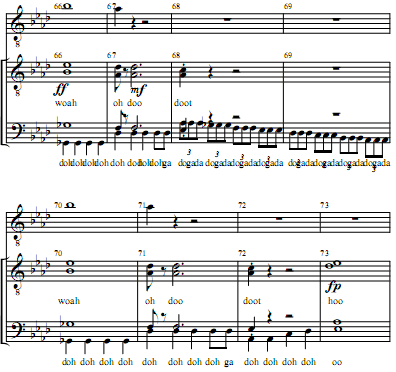
The same. In m73 there's an ambiguous chord: Eb7sus, but without the Bb. It's a way to dodge the piano solo and return to the horn riff.
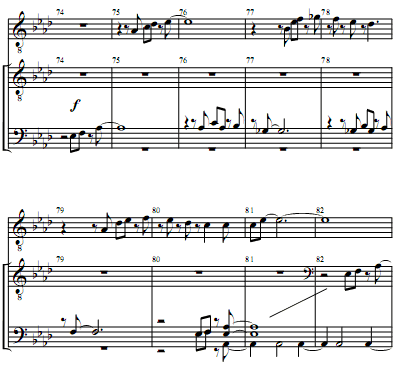
Pretty straightforward, only without the harmonies. Very bare and hopefully exciting, like horns calling out across a field. When the basses enter, they're hammering away on 2 and 4, and they will form a pedal point on the tonic. Beats 2 and 4 are where the snare is generally hit; and placing the basses here helps make the song dance ahead instead of plod heavily along.
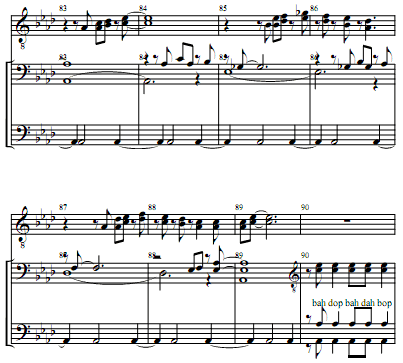
As the upper voices harmonize, another voice enters: in the middle system, a bass breaks off to fill out the middle of these chords with single notes. In fact, he is singing the roots of the chords while the rest of the basses squat on the Ab below. In m90 our pickup returns with new syllables. All "b" and "d" consonants, and every vowel is an "ah".
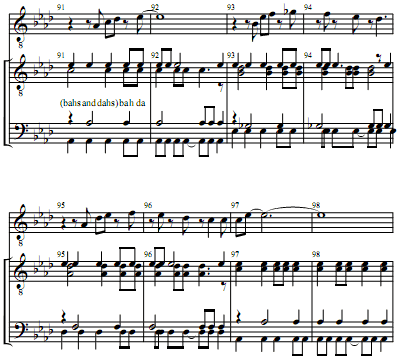
The rhythm used in this section is similar to that which came before, except altered to fill it out more with long notes. No more staccato. in the second measure of each pair, a constant eighth-note rhythm is split between the parts for the first three beats (T1 to T2 to B1). Then, in m97 and m98, a declamatory set of rhythms that's a bit more hammering. Notice the top descant part that's soaring above the mess, and how the basses have joined the group on the "ah" syllable. All voices are easily within their sweet spots, and they're not changing notes -- this makes this section easy and fun to sing, and very effective. It's a wall of sound and sounds very active but not weak. Usually, giving parts unique material will make the block sound active but potentially disorganized and usually weaker. In this case, the rhythms used are carefully split and driving.
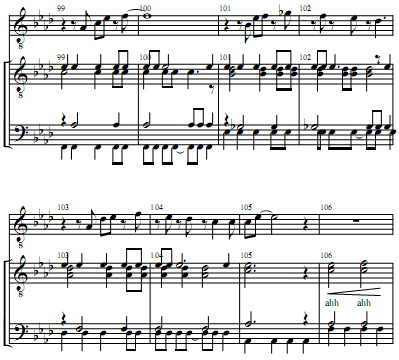
This time through, the basses hit the F down low, with power, in m99. From here on out, it's more of the same.
Unlike in Don't Stop Me Now, there is very little interplay between the soloist and the block. Also, although the parts tend to work together, they are much less rhythmically united in the verses. This back and forth between the rhythmically pounding sections and the long sweeping notes is the basic formula used. Aligning vowel sounds makes the block sound strong as one, and using different vowels on one part (especially the basses) can have a very large impact on the sound you ultimately get. Writing in the middle of peoples' ranges always makes for a good happy group.
Download a PDF of this arrangement
As usual, if you use this arrangement, drop me a line and let me know -- I like to get an idea of how much these are being used.
Published Sat 25 October 2008
This is a delightful track that bears closer scrutiny. It begins in an ambiguous 6/8 and 3/4 that also has an overriding 4/2 feel in the vocals that combines two measures at once. This is already incredibly clever, but at 0:38, suddenly we're thrown for a loop into 4/4, with syncopated melody. Then, there's a section that seems at first sound to be a hemiola, but in fact is the imposition of three measures of 3/4 and a measure of 2/4 (for a total of 11 crotchets!) into the established 4/4 timeframe. All this time, of course, there's a pulsating and smooth polka-derivative background that emphasizes each quarter-note beat evenly and smoothly, letting the rhythmic changes flow surreptitiously.
This is from the movie soundtrack. I'm generally not terribly huge on musicals, but Bernstein (pronounced like the giant mug of beer, and doesn't rhyme with the small sweet orange citrus fruit) is a truly learned composer and conductor who was terribly aware of his environment and the state of his art. Finally, many kudos to the vocalist, Jimmy Bryant, for his endearing performance and delicious final note. Quite incidentally, he performed on the Batman TV show theme song, composed by the late great Neal Hefti; may he rest ridiculously peacefully.** **
Published Fri 24 October 2008
From time to time, I'll be posting arrangements from the Broze Brothers collection, along with in-depth descriptions of the techniques used and why. Take them as arranging tutorials.
Don't Stop Me Now by Queen. TTBB, as sung by The Achordants.
A firey and energetic song, to say the least! This arrangement is challenging but rewarding, and lays most of the driving momentum in the hands (mouths?) of the basses. The original track and complete a cappella arrangement are just below. The a cappella recording is a bit rough; it's just multitracked as I read from the score, but it gets the job done.
Below is a line-by-line analysis of the arrangement techniques used:
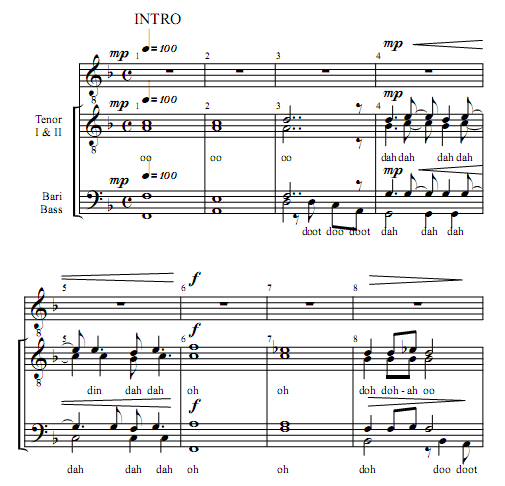
The intro begins with full block chords, with matched vowels straight through the ensemble. The voice is good at sustaining pitches like this. All voices are moderately spaced, using traditional voiceleading rules. The bass is the voice that most often breaks away, usually as pickups to the next measure (m3 provides motion to cover for the breaths above). m5 contains a bell chord arpeggiation. m5-6 has a vowel change without an interrupting consonant. Note the syllable choices -- very very simple consonants so as not to interfere, and only three basic vowel types. Pure vowels are your friends!
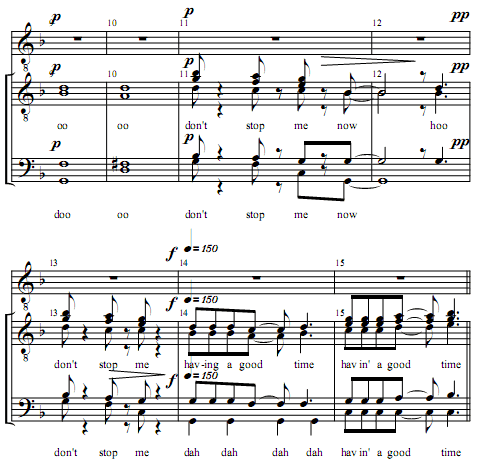
The Tenor Is split; it is usually better to split the highest voices first (and also have fewest people singing the highest parts). Note also the compression of intervals between the higher voices: space upper register singers more closely. m12 has a sustained bass part to provide connection, but the upper voices break off and punch in with an offbeat "hoo". This provides forward momentum, and the vowel mismatch with the bass makes the arrangement sound to be gaining layers. m14 the basses begin to pound away and hint at their timekeeper role later.
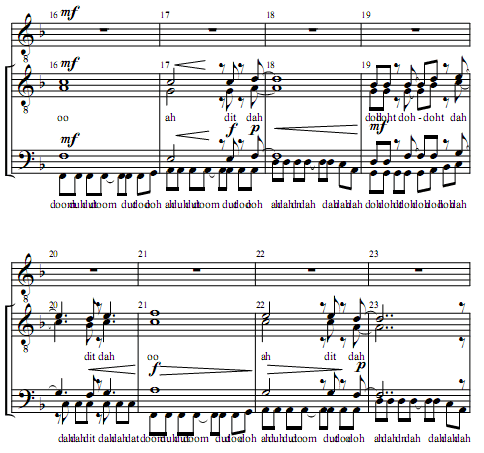
The real texture begins. The basses are running this program with a repetitive rhythm and sometimes walking line. In m19-20 their rhythm's syncopation helps create tension before they return in 21. The upper voices are working as a unit, sweeping along on long notes with offbeat accented entrances, and exaggerated dynamics. In m19, the offbeats are again emphasized. In m21-23, the same material as in m16-18 could be used, and indeed the bass part is just repeated and the upper voices use the same rhythms. However, the upper voices do the opposite from the first time, by descending melodically AND dynamically. This makes this 8-bar phrase sound like a unit with a gradual rise and fall, and helps keep the piece from sounding too "blocky". Note too that Queen is really using 5-bar phrases; this 8-bar superposition makes for an even more flowing sound, with no clear starts and stops.
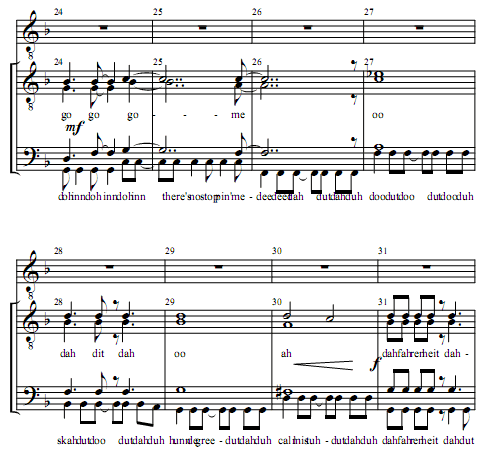
The upper voices are harmonizing the soloist by stealing his syllables and words, while still maintaining their sustained note in m25. The basses here are switching to a new syllable to match the upper voices, and in m25 they are singing along with the soloist, making a connection from the very top to the very bottom of the group. This is a very useful trick to unite the sound of the whole, and it used very often in this arrangement. In m28 the basses have "skah" written to match the soloist's "sky" -- this is done to keep them on pure vowels and maintain the integrity of the bassline. In m24 note the C7 chord without the third: in rock especially, dropping the third is perfectly fine on this chord. A similar thing happens below in m39, where a C9 (gm/C) is "resolved" upwards through a C7 chord to an F. Remember that gm/C is close to a C9, and can act as a slightly weaker dominant sound; adding the E makes it stronger.
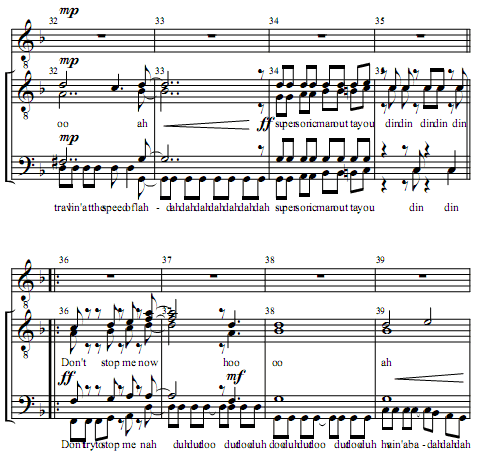
All four voices on the pickup to m33 are punching an "ah" syllable at the same time as the soloist ("light"), which creates sudden unity before a massive crescendo m34 sees homophony, and then in m35 the important piano part is split between the upper and lower voices. In m33, I shouldn't have written that rest in there -- very bad call. Ignore it. The syncopated rhythm in the upper voices in m36 is incredibly challenging for many musicians, and they will generally rush them beyond recognition. To remedy this, the bass part was filled out ("Don't try to stop") in order to audibly subdivide beats 1 and 2. The upper voices hear this and never rush. In m37 we have a return of our "hoo", and sustained notes allow for an easy to sing buildup of excitement. The dynamic shifts in this arrangement are the key to separating "backup singer" parts with "background instrument" parts.
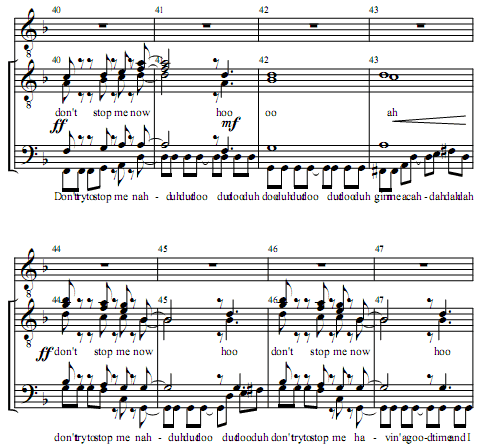
More of the same. Notice the upper voice is the one that's split, and the bass part is getting more complex and interesting (difficult!) underneath the tops. And also, time and time again, "oo-ah" is written instead of "oo-wah", since writing the 'w' would tend to make the choir scoop and punch in strange ways. "oo-ah" avoids this!
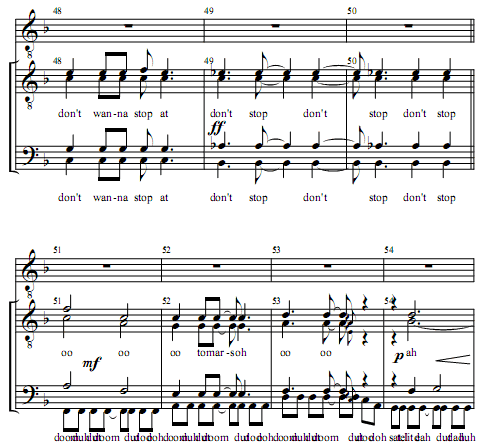
Homophony returns with strong and simple voicings near the middle of singers' ranges. Note the baritone line in m49: the half-step between the G and the Ab is relatively small (Ab is lower than G#), and the half step upward from the Ab to the A is a rather large half-step indeed. If you try this chart, make sure your guys know to be very careful in slotting the Ab lower than they might otherwise, and then resolve it by surprise to a very buoyant A natural on the downbeat of m51. Here, the second verse begins with new material -- there is no repeat. In m52, the upper voices are echoing the soloist's "to mars" line, although it's written with the "soh" as one syllable to encourage its proper placement. In m53, the upper voices use a stylistic fall-off. The bass continues to sing lyrics.
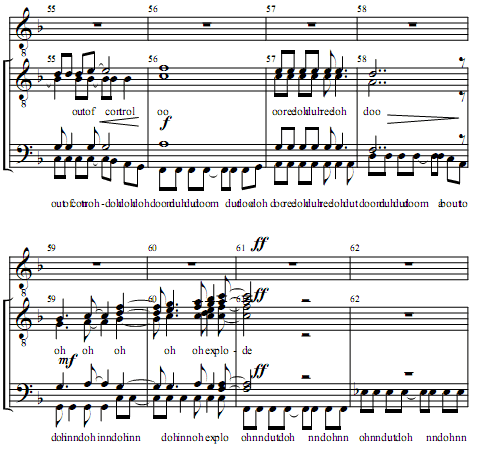
"Out of Control" has a strange rhythm to be confusing -- I would rescore it to be more crazy if I were to do this over. "Reload" in the solo is echoed in m57 as "oo ree loh duh ree loh -- doo", phonetically spelled. The most split parts occur in m59-61, and this height of intensity is underscored by a complete removal of all but the bass for the next two measures.
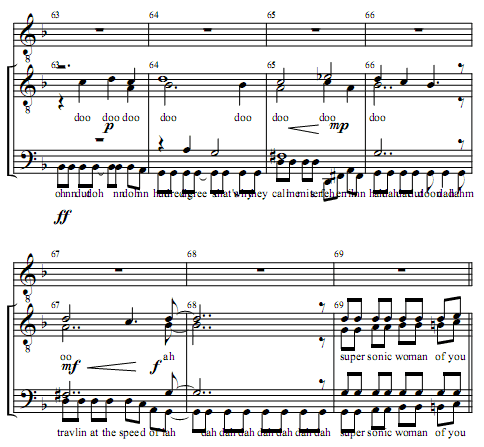
The basses are treated almost as a soloist, and have an elaborate part with lyrics in time with the soloist. Upper voices enter with a completely new texture: something simple and contrapuntal, with individual lines weaving in and out. Imagine a traditional choir, but by m67 they're back in action.
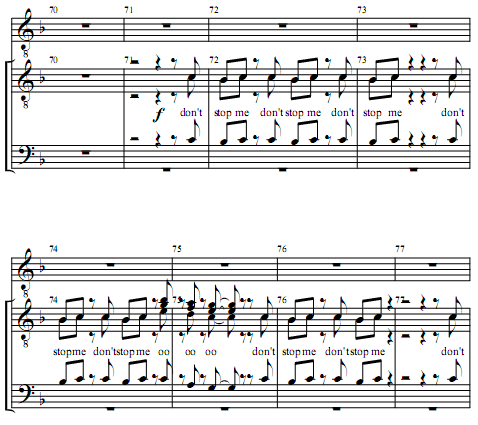
The basses drop out completely, and except for m75, this is all unison. Lifted directly from the original.
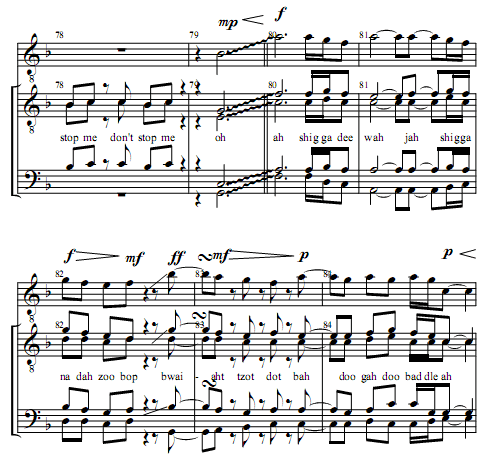
Ambitiously, a breakaway group of five singers have a fully harmonized version of the guitar solo. The syllables were written just by scatting freely over the solo section. Alternately, a single person would sing the solo as the group repeated to the first verse.
Now for an example of how this works with a soloist. Freddie Mercury I am not, but you'll get the idea. Listen for how sometimes the backups are reinforcing the soloist as a block by using the same vowels or even words and rhythms, when the basses alone are reinforcing the soloist by using the lyrics in the bassline, and then when the entire block is getting deliberately out of the way during the important part of the soloist's lines. The verses and chorus alternate between singing their phrases along with the soloist and in opposition to him. In general though, block chord often use the most important sustain vowel of the soloist when a strong sound is desired, and a different one when the soloist is meant to be heard distinctly.
To say a word of process: this arrangement was written entirely with the voice, and not with Finale -- Finale was only used as a notation tool after the fact. So, over a looped recording of the original, I'd recommend singing various parts that pop into your mind, and then building the arrangement around these naturally improvised parts. This keeps the syllables and dynamics a crucial part of the partwriting, as they ought be; additionally, most lines tend to be very singable with good voiceleading. If you want to download a PDF of this arrangement, click here:
Broze Bros - Don't Stop Me Now
Finally, here is a YouTube of the Achordants performing the arrangement:
[youtube]http://www.youtube.com/watch?v=HGsOjI0_2-E[/youtube]
Published Fri 24 October 2008
Pretty tremendous work, again! This one isn't AutoTuned, which somehow makes it more incredible. Finding the pitches in the voice is so impressive to me.
http://www.youtube.com/watch?v=9nlwwFZdXck
More here.