Stacoscimus Blog

The Music We Say

Published Sun 07 December 2008

That would make a pretty grand book title wouldn't it?  Dibs!

I have been thinking about the musicality of inflection patterns in day-to-day speech (previously here, here), and my friend Jason brought some new information to light on the cognition of speech and music.  As it turns out, some new research is being conducted on this very phenomenon.  Via New Scientist:

Diana Deutsch, a psychologist at the University of California in San Diego, first noticed the illusion in the mid-1990s when editing a recording of her own voice. One phrase - "sometimes behaves so strangely" - began to sound like a song when she replayed it several times.

Now Deutsch has confirmed that the illusion is real by testing it on proficient singers. Those played the same phrase just once and asked to repeat what they heard, spoke it back. But those who heard the phrase many times, sang it back.

The audio they mention is here.

Well, after listening to the track, I dutifully sang the phrase back.  It's set to a repeat that places it comfortably in common time, and as it repeats, its melodic character certainly is enhanced.  It seems as though our brains are programmed to ignore pitch as long as we're parsing syntax and grammar, but when we are no longer seeking more linguistic data, we're free to hear the sounds as music.

Also produced spoken-word music of a rather different sort.

Does this have something to do with my great difficulty in understanding lyrics in song?  Some hear them loud and clear, but I find myself consistently struggling to pull consonants and vowels out of the pitch data as I listen to new music.  Likewise, I cannot seem to concentrate on studying, say, axial blood vessel configuration whilst I'm listening to music.

Regardless, these investigations open up the idea of the unperceived symphony we all are constantly humming as we buzz about our daily lives -- how much music is being created and heard but never digested?  "Paging John Cage; we need you!  It's a haptic music emergency!" Also, please listen to Shatner's spoken word miracles.
Jackson Five Rehearsal, 1970

Published Sat 06 December 2008

If you have been involved in producing music for stage or recordings, you are probably well familiar with the trials and tribulations of rehearsal--especially when your bandmates have trouble focusing and a penchant for doodling around.  Or is that diddling?  Either way, I'm quite reassured to know that an act as high-quality and successful as the Jackson Five had quite a similar way of doing it, even forty years ago.

http://www.youtube.com/watch?v=MFoK_aMiY3I

Young Michael had some moves; looking over his shoulder out at a large empty auditorium is very familiar; all of them are surely imagining what the place might look like when it's full.  Hearing the false starts and the variations of the playing gies the impression that this music as performed live was much more organic and active (and prone to error) than the stadium mega-concerts that are lip-synced today.  It makes me want to bust out a Jackson Five recording or two!

An update

Published Wed 03 December 2008

Forgive the gap.  Here is what has happened:

  1. I went to an AMS/SMT convention in Nashville and learned about the true state of Musicological research.
  2. Managed to move to New York City.
  3. Cleaned everything up, got some furniture, food, and a good sense of the city.
  4. Finished a long essay on Chopin's Op. 31, applied to 7 graduate programs (ahead of the deadline!).
  5. A bachelor party, wedding, and Thanksgiving.
  6. Multiple job interviews and prayers for an income.

But now I am back and ready to go.  I will again be posting my musical progress and interests here, starting today.

J.S. Bach - Prelude and Fugue in C# Major

Published Tue 04 November 2008

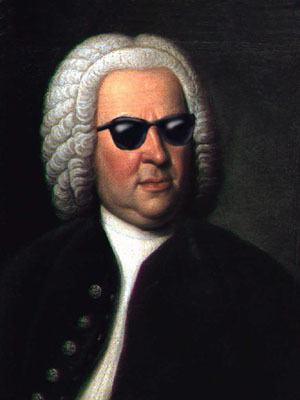
He's on a mission from Gad.

From The Well Tempered Clavier.  Two tracks:

These two are particularly charming!  They are the fifth and sixth pieces within the Well-Tempered Clavier, and carry with them a certain spunk and personality -- Bach was clearly writing with the intent of showcasing the tonal possibilities of all twelve keys, and accordingly the merits of well temperament.  Immediately after the very famous preludes and fugues in C major and C minor, the C# major counterparts showcase a glib, enthusiastic, thorough, and entirely endearing peek at the possibilities of what Bach must surely have considered extended tonality.  The Prelude is almost a taunt, an excited dance which dares to challenge, but never loses its friendly optimism.

In this recording, the notes sound conspicuously like sharp notes and not flat notes, akin to Db major.  I am yet to discover if the particular chord changes of Seventeenth Century works as compared to those of the Ninteenth Century in fact match these -- however, I get the distinct sense that this prelude in particular is "sharp" in nature, and constantly strives upward along the circle of fifths .  It might be due to the tuning of the particular piano, also.  Nonetheless, the persistent presence of an E# sounds like Bach's biting his thumb quite deliberately.

In any case, enjoy this set, and see it as Bach's joy at having discovered a system of intonation which allows him to play such unexpected games centered around an impossible tonic.  This prelude is purely a delight in a new discovery, altogether with a good-natured teasing of the nay-sayers, who still can't quite comprehend the enlivened frolick.

These two are played by Glenn Gould in 1965.  It's noteworthy that Chopin would always play Bach prior to public recitals; nothing else could adequately prepare him for the independence of melodic line he would require.

Happy Birfday to Me

Published Mon 03 November 2008

Birthday cupcake with candles

A personal digression -- 25 wooo!

That is all.

Flos Ut Rosa Floruit

Published Fri 31 October 2008

A Notre Dame conductus from sometime around 1200. I'm worn out from writing admissions essays.

http://www.youtube.com/watch?v=KLARJR8MLq8

This is haunting -- only the most perfect consonances were treated as such; octaves and fifths are very common.  I am reminded of Arvo Part's thinking in which he grants each line its own identity.  Here, the upper voices are not tied to functional harmony, so the lower melody does not implicitly bear the burden of chordal roots.

Update: It occurs to me that this type of piece would make excellent listening directly prior to any appreciation of J.S. Bach; the independence of voices and the implicit assumption of their absolute equivalence was still paramount in his day; it was only later that the movement of harmonies would truly become the predominant vehicle of music.

Stevie Wonder - I Don't Know Why, For Once In My Life

Published Fri 31 October 2008

Wow -- the difference in quality in writing and composition between these two songs is pretty staggering, but Stevie absolutely was learning as he went.  The return of Diana Ross in this one, for those who were wondering what was about to happen after that last clip a few days ago.

http://www.youtube.com/watch?v=tlHf-v2DgOk

It's pretty striking how many jokes fell absolutely flat -- the comedy writing for this show was rather poor, and the audience sounds somewhat canned and respectful.  I know that when I'm on stage (especially if there's somebody wearing sequins), I love a raucous and enthusiastic crowd!  The philosophy of returning stagecraft in music to the event of the night (a la Rat Pack) is something I'll probably rant about many times in the future.

At 3:49, during For Once In My Life, check out how the saxophones are playing the flute/piccolo parts from the original recording -- at the time, the stage musicians were reading from the original orchestration (listen to the more-amateur choir!) and didn't have the instruments or the facility to play these woodwind parts on the flute.  Not to disparage at all, just thinking about the resources available and how the same composition/arrangement could be deployed in multiple different environments with great success in all.

What a grand performance.  Stevie is incredible.

Update: Best moment is 3:54-3:56.  Diana points to herself, and is kinda a ham, but still very entertaining.  There are some stiff jokes in here that were written for Stevie as being full of himself, but don't actually match his personality.  She's an experienced stagecrafter, who is constantly interesting and engaging, even when her stage presence is meant to be secondary.  It's also worth remembering that Berry Gordy originally hated the hip and uptempo version of "Once In My Life," refusing to agree to its publication.

Stevie Wonder is young, talented, enthusiastic, and completely unaware of any stage drama.  He's blissfully clueless.  Diana Ross, on the other hand is a fantastically seasoned performer: sexy, talented, and aware of how to best handle the situation.  She wins the night, while Stevie will laugh about it later, slightly embarrassed at his younger self.

Orientation

Published Fri 31 October 2008

I'm an introvert -- I love people and I'm very social, but I feel like I need to recharge with some alone time after a period of social activity.  Extroverts are those people who can enjoy being alone, contemplating things, and getting a chance to have some time in their own heads, but afterwards, they feel like they need to recharge by spending time with others.

One day I will investigate clinical definitions of this.

Stevie Wonder - My Cherie Amour

Published Thu 30 October 2008

The goodness just keeps coming.  Here's more Stevie, live in his youth:

http://www.youtube.com/watch?v=gc0Xly5s1Ak

More tongue-clicking at 1:29!  And he looks like he's sitting particularly low at the keyboard; this might have something to do with what they tell me about him playing without his thumbs.  The ballet dancer superimposed is pretty fantastic, but more so is the realization the Stevie Wonder is one of those people who simply does not sing out of tune -- it's obvious from the deviations from the recording that he's singing live, but he's always spot-on with his pitch.  The only person I've met to truly do that with such ridiculous (near-mechanical) consistency was Phillip Childers, in the Achordants.  Wowzer.

Now try this one:

http://www.youtube.com/watch?v=KP3aXv_RioE

The pitch is still ridiculously spot on, but the phrasing and the performance are much more "Greatest Hits"-y.  After all that time, the inspiration for singing a beautiful song is largely gone, and the natural spontaneous enthusiasm has left; in their place is a near-craven desire to spice it up somehow, lest the magic be gone.  Concerts like these are important to honor a great hero, but nostalgia does not equal innovation.  Stevie applies new musical styles to this performance; however, I always imagine he is much happier when he is producing new material.

The biggest hurdle, I imagine, is that those who grew up with his music are not longer looking for new music -- only reminiscence.

Newer Entries Older Entries