I've stumbled across a really excellent performance by a spirited a
cappella group with an arrangement that really caught my eye. Of all
the others of this song I could find (save the Stereotypes), this is the
only one that was particularly entertaining:
http://www.youtube.com/watch?v=ZBR5rFh9gBs
Here's why it works so well:
These guys are fantastic performers, and are so comfortable with
what they're singing that they can rock out. The arrangement is
excellent because it allows the singers to do just that.
Maybe most importantly: a (somewhat) independent bassline supports a
block of uppervoices which is essentially singing in homophony.
Putting all the voices together like this makes the backups much
more monolithic and less complex, but the strength it brings is
undeniable.
The arrangement is written right into their sweet spots as
vocalists. Best yet, it plays directly to their strengths with loud
and resonant sustained notes -- this is a very vocally conscious
arrangement.
There are many repeats in it, which means it was probably possible
to learn the notes quickly, leaving much more time to work on
performance aspects.
The tenors are written well within the clef; all parts are low and
in a comfortable tessitura.
The words in the background go by fast, and are sung by the entire
group at once, which makes them oddly easy to ignore as a churning
of the block's accompaniment.
For another take on this (mine), see this
page.
I am strongly in favor of elevating the quality of a cappella
arranging on college campuses today; these guys are an example of what
makes a cappella singing cool.
"Wait, what? What's a Consovowel? What are you suggesting?"
Well, a consovowel is a syllable, quite simply. Or perhaps it's every
sound you hear at any given point. Or perhaps it's the sum total of the
arrangement. Really, I'm trying to make the point that consonants and
vowels are fundamentally different beasts (we're ignoring nasals like
/n/ and /m/, or anything /r/-like, okay fancy-pants?). For the purposes
of arranging for the voice, think of consonants as anything that
articulates -- they're essentially vocal percussion written into the
score. Vowels then, will refer to anything sustainable -- at least for
now.
"Why is this particularly important when considering small-group
four-part arrangements?"
Well, imagine you have one person saying "tah tah tah." Somebody else
decides to join in and says also, "tah tah tah." If you've sung in a
choir before, you know that these /t/s are not going to line up quite
right; it takes a lot of practice and precision to get this done. It's a
good skill to work on! But a corollary to this is that if the second
person were to say only "ah ah ah," the first person's /t/s would be
loud and distinct enough for the listener to essentially hear "tah tah
tah." This same principle applies in arranging.
"Yeah, so?"
So articulation of a part really needs only to be done by a single voice
to get the point across. With limited resources, you might be forced to
assign a three-note guitar chord to only one voice part! The good part
about this consovowel dualism is that it allows the listener's brain to
fill in the rest, based on what it is already used to.
"I bet you have an example handy, right?"
Indeed. Here are the first seven bars of a TTBB arrangement of
Everlong by the Foo Fighters. If you do not know this song, then I am
old. First, the original tune's intro:
Here we have seven bars of solo electric guitar, very quiet. This very
very quiet part, although accomplished in the original by reducing the
instrument number to only one, will be accomplished in the vocal
arrangement by writing a "p" underneath. At least, it should have been
written underneath. In any case, trust your group's ability to sing
softly, and be aware that reducing the number of singers does a very
different thing with a cappella groups than it does in a pop recording
-- especially with smaller groups.
Then, the second seven bars contains some of the same thematic content,
only with some swooping guitar chords and bass notes. The chords of
both guitars now are quite dense and complicated. How on earth to do
this? Simple. Since all we are hearing is consovowels, that means we
can mix and match our consonants and vowels in any way we wish -- that
means we can have parts that imitate polytonic instruments while only
singing their most obvious note -- or even without singing any notes it
plays at all! All that's most important for textures like these is to
have the rhythmic contentof each part in place, coupled with
generalized pitch behaviors. Let's see how this recombines.
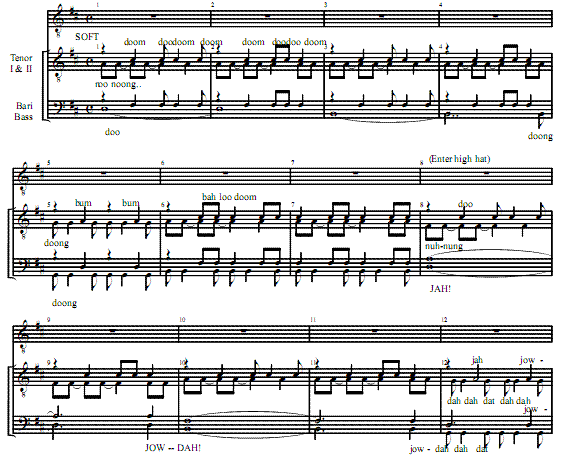
The Arrangement's intro by Yuri Broze, sung NEVER by ANYBODY. Really. If you would like to, I'd love it.
The First Seven Bars
Bars one through seven use all the singers in order to produce a quiet
guitar sound. They also introduce a general rule of three for
arranging: try to keep your block down to three different "things"
happening at once for maximum impact. As you add more, it becomes more
difficult for the audience to comprehend what's going on. Of course,
please play around with this and break the rules whenever possible, but
having three "things" in the block at once forms a very happy starting
place. Here, we have:
A sustained bass note, which turns into a rhythmic bass part.
A repeated "A" in the Tenor II part, which provides rhythmic
interest from the original.
The main guitar "melody," with its characteristic rhythm, harmonized
between the Tenor Is and the Baritones.
So we start with an interesting split, and all voices are singing on the
same /u/ vowel, for some pretty remarkable unity. Also, the vowel is
nice and quiet. Fantastic! Next, we'll have to add in two more
instruments (bass and second guitar), and somehow make the arrangement
seem as full. Here's how it works:
The Second Seven Bars
A sudden scuffle and now something entirely different is going on.
Again, it's three "things":
The sustained Bass and Baritone open fifths barge in on /a/, and /j/
makes it sound all gnarly (read: dorky). The open fifths stand out
hugely along side the vowel change and the dynamic change. These
open fifths are not what appear in the original, but they work
particularly well with the voice, and sliding them around with good
intonation is a very effective vocal game to play. Score!
The Tenor I, being the topmost part and easiest heard of the old
melody, forges on without its Baritone companion and holds its own
very well. Even though the Baritone part is no longer underneath
it, the rhythm is still represented, and the melody on top is in
place -- the listener's ear doesn't miss it.
The Tenor II stays on the same rhythmic part to continue to suggest
what the other guitar might be doing on the repeated note, but now
that it's not so exposed and is in the middle of the texture, it's
free to switch notes and fill out the chord as needed. Its purpose
here is only rhythmic; its notes are generally very wrong.
But it doesn't matter -- the arrangement sounds powerful and full, even
with four voices, because we were willing to loosen our grip on melody
and harmony, and let consonants in one part imply pitches continuing to
be sung in others. In so doing, we switched the pairing of
harmonization from Tenor I/Baritone to Baritone/Bass; this moved the
center of attention drastically and made the highlighted part stick out
with a strong timbral shift. Here's the Original again, followed by the
complete intro from the arrangement:
If history is any indicator, a great many new aspiring arrangers are
members of newer groups with fewer members than the large swaggering a
cappella groups that resemble a small construction team on a government
contract, only slower-moving. In fact, I would wager there's a
reasonable chance that you personally are a member of one such small
group, and are trying to determine exactly what sort of arrangement you
should attempt to create.
Following is an introduction to the time-honored tradition of the Four
Part Arrangement (A block of SSAA, SATB, or TTBB. Soloist costs
extra). Types of groups who might want to consider writing heavily in
four parts include:
Small groups with only five to twelve (5-10) singers.
Larger groups who have a tendency to sing some gigs with only five
to twelve people in attendence.
Women's groups, who tend to have a more limited
range
to work with in vertical pitch space.
Groups which predominantly perform in a live setting, and want to
focus their efforts on strengthening their in-person performance's
consistency.
Clearly, there's something for everybody here, and on top of
that, practicing your four-part arranging skills will help you in that
Music Theory 101 class that you just enrolled in. If you still haven't
done that, then get on
it! College is an amazing place, and you can learn all of these
theory skills without paying any more in yearly tuition (for most). And
please, tell your professor about SmarterMusic.
Four Part Harmony
For many many years, four-part harmony has been more or less standard --
if you'd like to learn more about how this tradition came to be, read
any number of historical treatises on music theory written around 1700,
especially Traité de l’harmonie by
Rameau. Regardless
of its origins, though, it has stood the test of time and is able to
produce most all of the chords we know and love with good voiceleading.
It's also happily thin enough that it's easy to hear each individual
voice within it. This can be a good thing -- it makes it difficult to
write an arrangement that is too cluttered. On the other hand, it can
also result in exposure of a few parts that you might wish were left
slightly less audible. Such is the gamble! At least you have a stellar
soloist to distract, right? Right?
Boiling down a song to only four parts can be both a fascinating
excercise and a fantastic enterprise; I do hope that everybody out there
in interweb world gets a chance to try it at some point! By working
within constraints, a composer/arranger gets the opportunity to be truly
creative, since there are real problems to overcome in clever ways.
That is to say, necessity is the mother of invention -- and if you
impose the necessity, you create the potential for innovation. Over
time, we'll highlight here some very clever reductions of vast
compositions to only a few voices. We'll also point out that many
apparently vast symphonic compositions are in fact essentially only
four-voice compositions. I'll do that now, in fact. Many symphonic
compositions are only written in four voices.
If you commit to only four voices plus soloist, you'll end up exploring
novel pairings of voices, dynamically changing as the song continues.
Also, writing all the percussive consonants into the score itself will
help keep your group from needing a dedicated vocal percussionist.
Finally, even after your group expands to larger numbers, you'll still
be able to sing the same arrangements with a big and powerful sound.
This is what Barbershop is all about.
On that note -- in First Principles / Setting the
Stage
we mentioned that it's a good idea for even large-group arrangers to
consider how many people might be available at a given gig. Each
soloist or descant singer will be singularly required to attend the
performance in order for the song to fly. And if a large group is split
too many times (ie five, six, or more parts), then there's a very real
possibility that an arrangement will turn out to be completely
unperformable in practice. Don't let this happen to you!
When Four-Part Isn't So Smart
Finally, there are some times where a four-part arrangement just isn't
going to cut the mustard. For example, mixed groups will often find
that SATB without splits is very awkward and thin-sounding, especially
for smaller groups, because of the difficulty in making cross-gendral
couplings sound convincing. Groups who want to work very hard toward
making their recordings sound as polished and produced as possible
should probably not try to reduce their arrangement to only four parts
-- this makes it sound more like a vocal piece and less like the
original instrumentation. Besides, in the studio, you can always try
another take (or let Antares AutoTune fix you up) if somebody is a bit
out of tune. Finally, groups who are made up of incredibly talented
singers and/or are seldom missing people during gigs will want to
seriously consider writing 6-, 7-, 8-, or even 9+-part arrangements to
showcase their strengths.
What's Coming Up
All kinds of examples of four-part arranging, geared toward smaller
groups, or those who are interested in writing arrangements that will be
performable by the largest number of groups. We'll look at all kinds of
things in the 4-part world, and also showcase some examples of
simplification in arrangement. Coming right up!
This case study is on subdivision in parts, both within the bass and the
upper voices. Additionally, we'll touch on a few other techniques, such
as accommodating vocal backup parts within your arrangement, changing
the feel of a tune, and arranging from memory instead of from a
recording. Let's shall, yes?
The tune of the moment is by The Temptations: "Get Ready." This is a
pretty fantastic classic tune that comes with built-in vocal harmonies;
but in the original version, we hear not only the backup singers, but a
full-fledged orchestra and choir plus rhythm section. How on earth to
boil this down to its root components? First, listen to the Temptations
themselves; the sample we'll be dealing with is the first line of the
chorus (I'll be giving you a love that's true, so Get Ready, so Get
Ready):
http://www.youtube.com/watch?v=rQdSJXPDtjs
One way to do this is to arrange from memory. Listen to the
song a number of times (or perhaps even only the part you're interested
in working on) until you have it well in your head. Then, sing it back
or even try to arrange it based on your memories. This process takes
advantage of your personal impression of the most important parts of the
song, and helps to create something that reflects your individual flair.
The following recordings were made without listening to the original,
since I happened to know the song very well from childhood. Listen again
and get it in your head:
So pause, take a breath, and sing what you think maybe one line of the
backup should be singing. Does anything stick out? What do you remember
as being the most important rhythmic moments? The melodic shape? After
you've done that, compare with what I came up with. Side note: The
recordings we'll be looking at were made as I was first learning to
sing, a number of years ago, so listen for the mistake of humming /n/ or
/m/ before the actual onset of the note. This is a big mistake that
makes your group sound muddy, so try to encourage other singers to
attack only on the starting consonant or vowel. Do as I say, not as I
do!
Example One: Pure Homophony
What I produced, of course, is not "right" or "wrong," it's only what I
happened to come up with. Yours might and should be different! What you
hear in this recording is a TTBB treatment plus soloist; the backup
parts ALL sing the same rhythm and the same words. This is called
"homophony." So where did the
partwriting come from? Two parts.
In the original recording, there is one section that seems to be
repeated in the chorus. Listen for the big grandiose choir there and
listen to what they're singing. First time through, it's something like,
"Ah ah ah ah ah. Get Ready, Get Ready." Second time is MUCH more
interesting, something like, "Ah ah ah ah ah, baby, Get Ready, Get
Ready." Should you include the "baby"? Signs point to "HELL YES!",
mainly because it's a hidden gem that makes the arrangement much more
fun to sing, and helps your singers from getting weary of counting
repeat signs in their heads. However, if your singers are not good
enough to the point that they can hold their own on sections like that,
it'd be fine to simplify and actually repeat the previous material. Here
today, we will only look at the first four bars, however.
After the choir sings their second "Get Ready," the string section
becomes much more obvious with two clear rhythmic hits on the "&" of 3
and 4. Hear it? These emerge from the texture powerfully, so it's a good
idea to include them in your a cappella arrangement. If I were to do
this over, I might do it more obviously (by adding a hard consonant to
each of these offbeats), but you can still hear them emphasized by a
change in notes on the word "Ready."
Example One had all parts singing in unison, and this article is
supposed to be about subdivision in the parts. So onward!
Example Two: Uppervoices Homophony, Independent Bassline
My friends, never underestimate the value in an independent bassline.
The moving bassline in the above example is improvised and not
particularly well thought-out, but it makes its point, with simple dooms
and the like all the way through. It stands out because its /u/ and /m/
don't match the /a/ sung by the block. It's not a particularly good
bassline, though, since it seems to interfere a bit. A better solution
would be to change the bassline such that it was a perfect combination
of the previous two examples: the bassline would be an independent line
of dooms during the long /a/s on top, and then would chime in with the
words "Get Ready" to match the rest and give the whole thing some unity.
Nonetheless, as it is, the group sounds like it has much more motion;
the job of the drum section and the bass player from the original is
done by this new rewritten bass part, and the arrangement sounds much
much more directional.
Example Three: Uppervoices Subdivided Homophony, Independent Bassline
One more example to show how subdivision might effect the upper voices.
Here, instead of sustaining an /a/, the upper voices punctuate each beat
with a /d/; this helps add to the percussion in the arrangement
(remember that vocal percussion is only a string of consonants, and
their jobs are interchangeable). It's a subtle change, and I'll leave it
up to the listener to decide which they prefer. Although adding the /d/s
to the voices helps make the harmony much more clear and to pound away
at the beat, it takes away some of the smoothness of the voice's line.
Remember, if you write for a group of a dozen college kids a whole note
as in Example Two, they're likely to fall flat on it and give it no
life; if you write a series of four quarter note /da/s, you'll get a
group of people jackhammering away inelegantly, distorting their vowel
each time they move their tongue up for a /d/.
This is not pessimistic, however! This is opportunistic and instructive:
which option you choose will determine which lesson you'll be teaching
through your arrangement -- which challenge the group will next
overcome. After they learn to sing whatever you write wonderfully, then
they will be enriched in that way, and better able to tackle the
next task thrown at them!
You Know, I Learned Something Today
Have faith in your mind's ear to recall what is truly the most
important part of the arrangement to include. Then, let your ears reveal
the special idiosynchrasies that make an arrangement fun to sing and
engaging. Subdivided, independent basslines can be used very effectively
to give motion and energy to an a cappella arrangement, since it can act
like a drumset and fill the rhythmic roles of the other instruments in
the original. The way you write the upper voices is likely to sound
different, but an amateur choir will exaggerate these differences --
score wisely and use the arrangement to help teach awesome musicians to
be even more awesome.
Yet again, another interesting and rhythmic recording from the great
jazz piano teacher, Lennie Tristano:
http://www.youtube.com/watch?v=FQZxUwpVQPo
His general lack of available recordings has made him a less celebrated
pianist than perhaps he deserves, as well as his unwillingness to fit
squarely into the burgeoning bebop style of his contemporaries. Jeff
would certainly whine about Lennie's big fat 10-note piano chords, and
this recording showcases plenty of these in all of their crunchy glory.
What's maybe most interesting to me about this particular recording (and
I don't have a title for it) is the way that Lennie's chords are so very
dense that they almost constitute entire modes or scales played at
once. The motion between them is difficult to decipher, but the
movement is clear.
His melody lines are clearly articulated but tend to refuse to gravitate
to the usual tonal homes of bebop. I enjoy how chromatic his playing
is; it certainly foreshadows his atonal ventures to come. Such a
strange syncopated jaunt this is! And though it's clearly in C minor,
do I hear an Eb as the final bass note?
Also, seriously, is that drummer playing straight eighth notes? Those
wacky Germans!
I will have to study his educational methods more fully very soon.
The more I see of Sammy Davis Jr., the more I have to love him. He's
singing a classic tune, updated to some funk/disco hybrid, while wearing
hideous striped pajamas and smoking a cigarette suggestively. He's so
skinny at this point too. I do wonder what the rest of the Rat Pack was
up to at this point.
http://www.youtube.com/watch?v=8RUNx06sk50
The arrangement is pretty excellent -- it was recorded sometime around
1970, and so was probably seen as a string of "covers" of Stevie
Wonder's fantastic up-tempo version.. in fact, he uses Stevie's
chromatically falling lick at 0:51, although he lays much futher back.
Sammy Davis Jr. is certainly of an older era of performers who never
wrote their own material, back in the days of the Great American Song.
The horns at the end repeating that lick bring this whole project
together as a funktastic groove that somehow just oozes "cool" at the
seams. This is a good study in horn arrangement of the era -- it's very
typical, but in a good way.
Sammy Davis's skinny self in that jumpsuit is such a ridiculous sight,
really, but not one that's particularly sad. I think of it more as an
apogee of achievement; it's the pinnacle of... something. I'm not sure
quite what, but it's certainly very far in whatever direction it is.
Perhaps the direction is "Tom Jones," which explains the alarming hip
gyration. But regardless, props to the James Brown scream in there. I
suspect that Sammy Davis Junior's time doing this is just evidence of
his success as an entertainer. He kept relevant no matter what; much
like the Red Hot Chili
Peppers.
Bonus: Soul Girls! Watch 1:48 to 1:58 on the left side of the
screen -- that gal does the clap and squat. I love the clap and squat!
Bonus 2: Sammy doing it again in 1989, after strutting onstage to
the Hawaii Five-0 Theme Song; the cigarette is gone and the hip
gyrations remain. I would say that the soulscream and the performance
is FAR more triumphant here, and if the 1970 version made me smile in
vague irony, this one from 20 years later makes me smile with joy!
SmarterMusic is growing in fits and starts, and the SmarterGuide to A
Cappella Arranging is off to a particularly fitting start! Two
consecutive music directors of the UNC Achordants (and chief arrangers)
are currently collaborating in various backrooms of the halls of
academia to bring you the most comprehensive and in-depth guide
available on the webotubes. It shall be in parts numbering three: First
Principles, Advanced Explorations, and Deconstructed Arrangements. Stay
tuned.