Earlier this summer, I finished reading Meyer's
Music the Arts and Ideas.
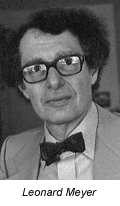
Now Leonard Meyer is no slouch in the field of music theory—his classic text
Emotion and Meaning in Music (1956)
has been endlessly cited for convincing music theorists that there might
actually be something to *gasp* empirical descriptions of musical
works!
Of course, I jest; it's only half-true. The postmodern wave in
the humanities was still a decade off when Meyer published his opus (the
same year as George Miller's
The Magical Number Seven),
and Claude Shannon's introduction of
information theory
was still tickling the minds of humanities scholars, who thought we might
have struck on an Urtheorie of culture. Well, the short story is: no
such luck. Humanities types retreated into hermeneutics and
hyperrelativism, and that seemed to be that for the time being.
Meantime, Leonard Meyer shifted his focus to studies of musical style,
since meaning was too fraught with postmodern peril. Oh, silly
academes.
Which brings us to Music, the Arts, and Ideas, published in 1967. The
book is something of a ragtag collection of essays, but there are some
common threads. Most importantly, Meyer sets out to describe how he
forsees culture in the postmodern age progressing. This happens to be
exactly the age in which I was born, so I figure I have a reasonably
good standpoint from which to evaluate his statements. But oh, what
statements he makes. Get a load of this one, chosen by flipping through
and pointing with my eyes closed:
Though analytic formalism and transcendental particularism are clearly
in conflict regarding the efficacy of causal explanation, it should be
emphasized that they do not necessarily disagree about either the
existence or the nature of causation. (p.163)
Woo-ee! now that's a humdinger there. Meyer is an incredibly well-loved
and much-missed personality, and deservedly so. But boy does it take
some effort to wade through his prose. Here's some reader's
digestif:

Meyer has learned from cross-cultural studies of the 20th century that
sayings like "Change is the only constant" don't really apply
world-wide. Sure, in Western history from the Romans on up, we've seen
a huge parade of history, a flowing river of chaotically repeating
eddies and flows. But looking around, it seems like stasis in
culture is far more "normal" than the constant bustling change that
we're used to in the Western world.
But what has changed, says Meyer, is that technology has grown to the
point that we are able to look back and enjoy recordings of music
produced forty years ago just as well as we can enjoy recordings of
music produced yesterday. All time periods and fads, all historical
styles are equally accessible.
So in the end, he describes rather effectively what it looks like for
culture to move to a steady-state system with local fluctuation. He
even predicts that, due to a "psychological accessibility of the past"
(p191), all sorts of recycling of old culture will take place.

Furthermore, we shouldn't be surprised to find that "A multiplicity of
styles, techniques, and movements, ranging from the cautiously
conservative to the rampantly experimental, will exist side by side…
past and present will, modifying one another, come together not only
within culture, but within the oeuvre of a single artist and even within
a single work of art." (p209)
Sounds like remix culture
to me. More distressingly, he seems to have a certain Williamsburg, NY
demographic pegged, but didn't correctly predict
the ultimately uncontrolled spiral of meta-snark and strangeloops of
ironic kickballing. We can compliment ourselves for those!