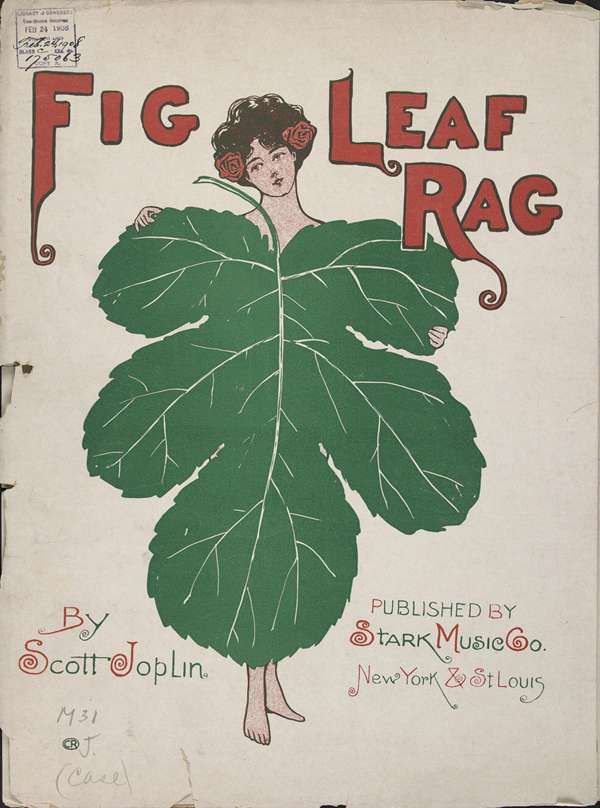
The Fig Leaf Rag is a composition nearly exactly one hundred years old,
penned in 1908 during Joplin's time in New York City -- I imagine he was
facing his 40s with a resolve to recapture a youthful exuberance he
might have had before, when he first struck out from Texas to make a
living as a pianist. However, at this age (and with two ex-wives), he
resolved to relocate hundreds of miles away to a city which might
respond to the credibility he had gained as a composer and pianist in
the Midwest.
In this era, of course, it should not be forgotten that communication
was slow, and radio had not yet been able to spread popular culture
throughout the country with such rapidity as television eagerly
disseminates the music videos of today. Joplin's successes in the St.
Louis area doubtless had afforded him much celebrity, but there was
little certainty in the promise that New York City might hold for him;
assuredly it was a romantic aspiration as well as something of a gamble.
The Fig Leaf, of course, preceded the amusingly (and ulteriorly)
entitled "Scott Joplin's New Rag" by four years! Regardless of the
intentions of the composer, it's clear that Joplin was at the very least
marketed as an up and coming talent, ready and able to impress with each
new composition! Even at the age of 40, you can imagine him trying to
begin anew after becoming newly a widower, capturing whatever flair and
spark of inspiration led him to the success of the Maple Leaf, and even
possessing the audacity to name his latest work in his implicit "Leaf"
series, with only the Palm and Rose Leaf Rags as intermediates.
However, the most direct successor to the Maple Leaf is undoubtedly the
Gladiolus Rag of only a year before the Fig -- coinciding with his
continental move more exactly, the Gladiolus is harmonically nearly
identical with the Maple Leaf and behaves almost as though to channel a
nostalgic sense of revisionism on the part of the composer. This being
as it is, the Fig Leaf then acts, at least partially, as an admission by
Joplin that he can no longer rely simply on proving his potential worth
on the happenstance successes of his past: he must begin anew at
defining his art, but without the crutch of reusing harmonic
progressions and generalized melodic motifs.
It's undoubtedly a conservative piece, and even titled as such: "A
High-Class Rag" written just following his introduction to the pulsating
metropolis of New York City, after leaving the more rustically flavored
St. Louis -- we must remember that the 1904 World's Fair had just
managed to transform what had been considered a gateway to the primitive
frontier life into an aspiring cosmopolitan cultural center, but still,
few were convinced. The Fig Leaf is measured and plotted carefully in
alignment with the most successful rags as yet produced, and is an
attempt to recapture whatever magic made his previous masterworks such
phenoms. There are few adventurous tonalities, few risks of
unplayability, and a profound danger of artisanal craftsmanship
replacing any particular artistic ambition with uninspired banality.
However, another art is present here: the ability to sculpt a popular
masterpiece. After all, the knowledge of what might please a pedestrian
audience is itself a valuable asset, and a capacity to deliver it with
flair an astonishingly rare attribute. In Fig Leaf, Joplin tries his
best simultaneously to introduce himself and the entire genre of ragtime
piano to a new audience, a class of esteemed worldly folk he likely
perceived as being far more cultured than the barroom regulars of the
Midwest. In fact, Stark's 1907 advertisement of another of his rags
crows its merits thus: "It is as high-class as Chopin and is creating a
great sensation among musicians." Evidently, Joplin, as much as he saw
Chopin as an inspiration in his compositions (particularly in the left
hand), it's unlikely that anybody in the nation was wont to see Joplin,
a negro from Texas, as anywhere near the capacity for prestige as their
Romantic idol from France.
If this inferiority complex could be credited with a particular aspect
of this 1908 composition, it would be its caution. Joplin seems torn
between the grandiosity and penchant for sentimentalism and virtuosic
playing of the great Romantic composers, and the very present and
forceful need to make his music accessible enough to the average pianist
(some would say Joplin was never more than mediocre himself). Thusly,
Fig Leaf became a straightforward encapsulation of the Ragtime genre,
with its moments of unabashed enthusiasm reserved for the final section,
where Joplin's piano-based impression of a Sousa band becomes his token
of brash emotionalism -- it is, however, tied to a decades-old idiom of
bombastic showmanship, which by 1907 had become quaintly commonplace.
Musically, in the Fig Leaf Rag, listen for the increasing complexity of
the piece as it reaches towards the D section. In particular, note the
(rest) eighth-eighth-quarter-quarter herald so typical of Joplin's works
-- in this piece, it's split between the upper and lower voices such as
to suggest instrumentation! There are multiple instruments at work, and
the fourth beat of these measures is enthusiastically trumpeted by the
left hand as a bassline pickup note. Listen for how insistently the
syncopated beat is sustained in the second measure of the melody (the
octave "c"s). Finally, the sharp contrast in style from the full-band
arrangement to homophony in the final 4 measures of the section.
The Fig Leaf is beautiful in that it perfects an art and encapsulates it
with measured and academic precision, while expressing itself
artistically in nuanced flair, without ever stepping beyond the
abilities of a typical pianist -- until the trio that is. Joplin was
doubtless well aware that many amateur performances would end after the
B section. The true treasure, however, was reserved for those with the
persistence to wait until the end. The trio, of course, sounds strained
and stressed, as though it fights against its own orchestration to sound
calm and facile, while still betraying its own difficulty -- it is
impossible to classify it simply in the same category as the opening of
the Rag.
If Joplin followed Chopin in his conception of high-class, the
continuously mounting challenge of the Fig Leaf is perfectly within the
framework: he proves himself to be a master of his art as effectively as
he introduces an idiom of his own to a new region. This he does with an
endearing hesitance that has persisted for a century.
PS. "She's Come Undone" by the Zombies has a hauntingly similar measure
as the second-to-last in Fig Leaf. More later.