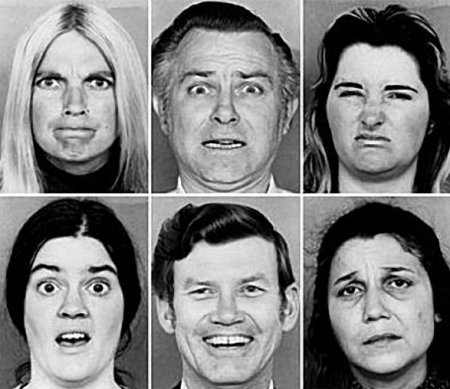
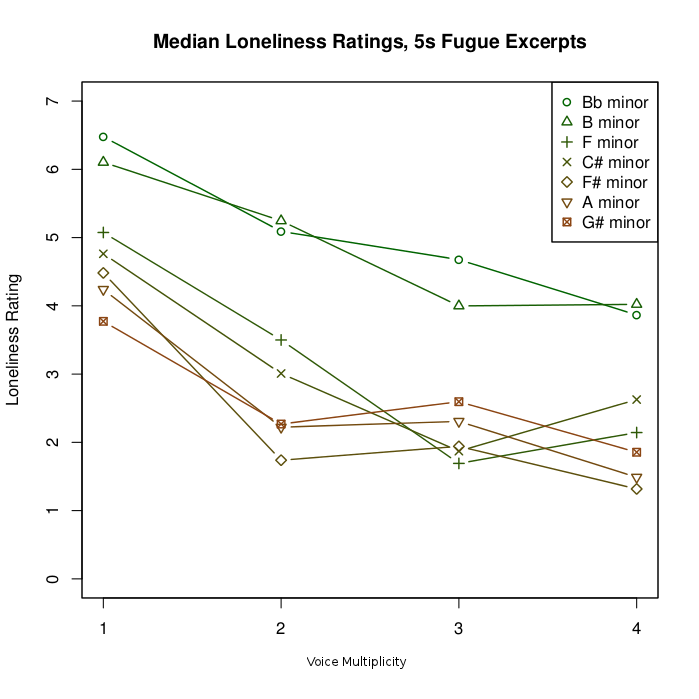
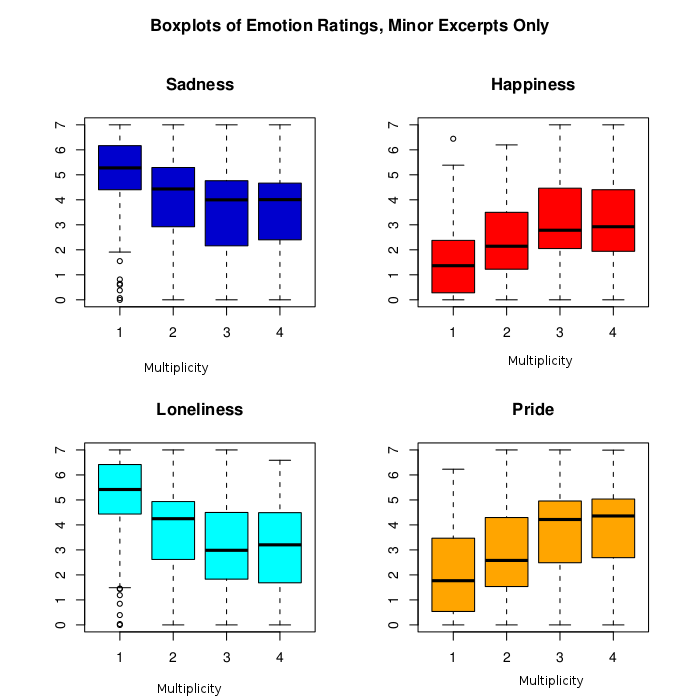
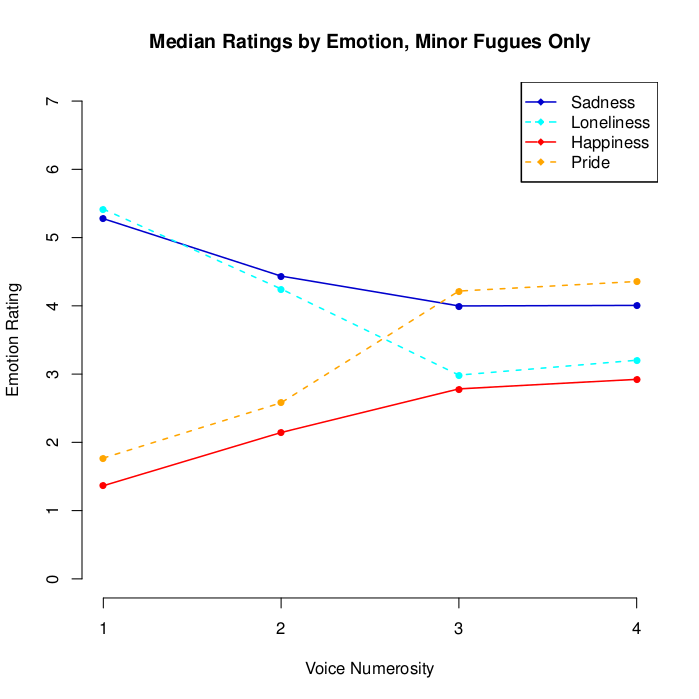
We asked OSU School of Music Undergraduates (N=25) to rate brief (5s) musical excerpts for expression of happiness, sadness, loneliness, and pride.
These emotions were chosen to provide two "basic" and two "complex" emotions, with one positive and one negative emotion per type.
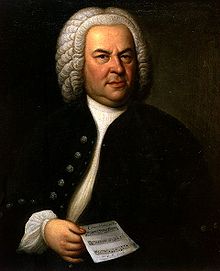
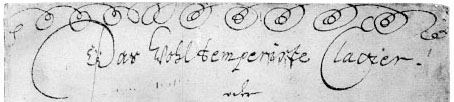
We controlled for musical style and mode by excerpting all stimuli from minor-mode fugues from J.S. Bach's Well-Tempered Clavier.
Four stimuli of voice multiplicity levels 1, 2, 3, and 4 were sampled from each fugue's exposition section. These formed sets of four, controlling for the effect of tempo, melodic content, and motivic content. In all, 36 stimuli were generated.
Recordings of harpsichord performances were used, due to the instrument's lack of dynamic control.
Furthermore, a single human performer was responsible for all textures, regardless of musical voice multiplicity.
For each participant, all 144 stimulus/emotion combinations were presented in fully randomized order
to be rated using an unlabeled slider in a computerized interface.
Following the experiment, each participant was asked follow-up questions to check for
possible demand characteristics, and debriefed.